
|
|
|
Accounting Scholar.com ® - Free Financial Accounting Principles Guide
There are 2 formulas we could use to calculate ROIC. (View Full) > Operating
Cash Flow - Managing Cash Flows Generated from Business Operations The Operating Cash Flow (Cash Flows from Operations) measures how further away Cash Flow is from the company's reported Net Income or Operating Income. Under the Generally Accepted Accounting Principles (GAAP), companies can report good Net Income numbers even though their cash flows are poor due to entries such as Accrued Revenues, etc. In simpler terms, Operating Cash Flow is a verification of quality of the company's reported earnings. Some financial experts argue Operating Cash Flow is a better tool of evaluating earnings than Operating or Net Income because a company can show positive net income but still not have enough cash to meet its debt covenants & obligations such as bonds payable, rent expense, salaries expense, etc. There are 2 formulas for calculating the Operating Cash Flow: 1) Cash Flow from Operations =
2) Cash Flow from Operations =
Differences between Operating Cash Flows and Reported Earnings indicates large amounts of non-cash expenses such as amortization expense, goodwill impairments, etc. If a company reports high earnings but with negative operating cash flows, this presents a red flag that it may be using aggressive accounting techniques that could mislead investors & public using the financial statements of the company. Operating Cash Flow is sometimes referred to as Free Cash Flow because this cash is 'Free' to be paid back to the suppliers of capital (shareholders and creditors). > Earnings
per Share - Measuring the Economic Value of a Stock Financial analysts use Earnings per Share as a way to determine the relative corporate value of a stock. The dividends declared on preferred stock are subtracted from Net income, and this number is then divided by Weighted Average number of Outstanding Common shares & its equivalents. Earnings per Share is very commonly used by the media to evaluate the value of a stock, e.g. if you go to Google Finance, you will see EPS in the summary of a stock along with other measurements such as Price to Earnings ratio, dividend yield, low & high range of a stock, 52 week trading high, etc. The two most commonly used formulas for calculating Earnings per share include: i) Earnings Per Share
or ii) Fully Diluted EPS
The 2nd formula where the denominator is # of Common Shares Outstanding & Common Share Equivalents is known as the Fully Diluted EPS. It is 'fully diluted' because all convertible bonds, preferred stock, convertible warrants and stock warrants & rights are included in the calculation. How EPS is Calculated Earnings per share is a way of standardizing a company's net income left over for shareholders across all companies. For instance, two Companies A & B could earn $10 million a year, but Company A has 50,000 shares outstanding while Company B has 500,000 shares outstanding. So how would you normalize earnings per share across these two companies?
> Price
to Earnings (P/E) Ratio - Calculating Earnings Growth & Relative
Value of Stock Prices The Price to Earnings ratio compares the current price of a common stock trading on the market with the Earnings per Share (EPS) that the company yields. Earnings per Share is calculated by dividing Net Income in current quarter by the total # of shares outstanding on the market. The price to earnings ratio is a widely used stock valuation tool as it indicates to investors how 'cheap' or 'expensive' a stock is and you will see analysts on Bloomberg television referring to the P/E ratio in part of their analysis & discussions about stocks. For example, assume Farhan Corp. currently has its A Class common stock trading at $45 per share and total # of shares on the market is 50,000. Net income as at February 28th, 2010 is $2million. What is the Earnings per Share?
Having this data, what will be the Price to Earnings ratio?
Earnings per share data of a stock is commonly found
in Google Finance or from the annual reports of your prospective
company. Another way to derive Earnings per Share is to estimate
based on the EPS of last 4 quarters. > Dividend
Growth Model - How to Value Common Stock with a Constant Dividend
and Steady Growth If the dividend grows at a steady rate, we do not need to forecast an infinite number of future dividends; however we just need to come up with a single growth rate which is a lot simpler. Taking D0 to be the dividend just paid and g to be the constant growth rate, the value of one share of stock can be simply written as:
This can be cut down to the following:
We have therefore just derived the dividend growth model which is a model that determines the current price or value of a share of stock as its dividend next period divided by the discount rate minus the dividend growth rate. Bank of America Dividend Growth Model Application - Example
a) Since we are already given the next dividend as $2 per share, we will not multiply D1 with (1 + g) as it is given as $2. Having said this, the dividend growth formula we will use is:
b) Since we already know the dividend in one year, the dividend in four years is equal to: > How
to Value Common Stock given Required ROI (Return on Investment)
and Dividends Shares of common stock are more difficult to value than say a bond payable because of three inherent reasons:
Deriving the Common Stock Valuation Formula Having said this, how can we value common stocks and discount them for the present values? Imagine that you buy a share of common stock today and plan to sell the stock in one year. From insider knowledge, you know that the stock will be worth $80 in one year. You also think that the stock will pay $8 per share dividend at the end of the year. If you require a 15% return on your investment, what is the most you would pay for this stock as of now? In other words, what is the present value of the $8 dividend along with the $80 ending value of the stock at 15% required rate of return? Here’s how to calculate this:
Therefore, the perceived present value of this investment will be $76.52 today. This formula can be put in more explicit terms as follows:
Where:
|
* Budgeted annual activity hours include direct labour & machine hours. Example Assume a factory calculates its predetermined overhead rate based on machine use or hours. Budgeted overhead is estimated at $600,000 while budgeted machine hours are estimated at 150,000. The applied overhead rate is calculated as:
During the course of the year, actual machine hours used to output the same amount of products is 145,000 hours. Thus, what is the actual overhead?
> Arbitrage
– Process of Buying/Selling Complementary Securities Arbitrage refers to the ability of investors to trade in complementary securities (buying and selling stocks, commodities or ETFs) in two different markets at the same time. The purpose of using arbitrage is to take advantage of market inefficiencies where one stock might be trading for $500 on the NYSE while it could be trading at $450 on the London stock exchange. Investors who engage in arbitrage are known as Arbitragers. Arbitrage basically takes advantage of the price differences between two comparable commodities or securities trading simultaneously on two different secondary markets or stock exchanges. An arbitrage investor (arbitrager) buys a security on the exchange with the lower price and sells it right away on the exchange that offers a higher price, for a profit or capital gain. The formula for arbitrage is:
Where:
Example 1 Say for instance Binti Kiziwi Corp (ticker symbol BKC) is trading for $80 per share on the New York stock exchange (NYSE) while it is trading for $95 per share on the Toronto stock exchange (TSX). An arbitrage investor buys 2000 shares of the stock on the New York stock exchange for $80/share and sells it simultaneously on the Toronto stock exchange for $95/share, thus making a decent profit of $15/share. The arbitrage profit will therefore be:
The arbitrage profit is $30,000. This transaction and similar transactions to this one will increase the value of the stock on the New York stock exchange as arbitragers will be buying and driving up demand in an attempt to lock in profit. However, the price of the security on the Toronto stock exchange will go lower because arbitragers will be dumping the stocks in that exchange in order to make their profits; for instance even if the arbitrager sells the shares at $93/share on the TSX instead of the $95 current trading price, he will still make a very good gain on his sale; this will therefore drive prices of that security on the TSX downwards. |
© Accounting Scholar | Privacy Policy & Disclaimer | Contact Us |



 Return
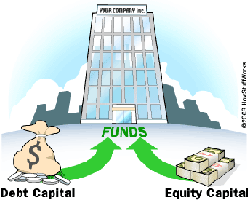
on Invested Capital (ROIC) is a top level way to measure
the historical & current performance of a corporation across
all the capital it has invested in its business. This capital comes
from shareholders (investors), creditors who supply loans, credit
as well as shares owned by management. One of the best ways to measure
how a company has performed in the past on its allocated capital
resources is by the Return on Invested Capital ratio. Other similar
formulas such as the Discounted Cash Flow (DCF) measures the performance
of a company based on its present & future cash flows, but they
are easy to manipulate. For instance, a company could easily decrease
its outgoing cash flows by:
Return
on Invested Capital (ROIC) is a top level way to measure
the historical & current performance of a corporation across
all the capital it has invested in its business. This capital comes
from shareholders (investors), creditors who supply loans, credit
as well as shares owned by management. One of the best ways to measure
how a company has performed in the past on its allocated capital
resources is by the Return on Invested Capital ratio. Other similar
formulas such as the Discounted Cash Flow (DCF) measures the performance
of a company based on its present & future cash flows, but they
are easy to manipulate. For instance, a company could easily decrease
its outgoing cash flows by: Bank
of America announces its next dividend will be $2 a share and from
research we know that investors typically require a 14% annual rate
of return from American banks, thus this will be the required rate
of return. The bank increases its dividend at a steady rate of 8%
a year. Based on the dividend growth model, what is the value of
the Bank of America stock today? What is the value in 4 years?
Bank
of America announces its next dividend will be $2 a share and from
research we know that investors typically require a 14% annual rate
of return from American banks, thus this will be the required rate
of return. The bank increases its dividend at a steady rate of 8%
a year. Based on the dividend growth model, what is the value of
the Bank of America stock today? What is the value in 4 years? Applied
predetermined overhead rate is a cost accounting method that applies
estimated labour or machine cost per hour to total # of actual hours
in a given period, to derive the total cost of production, whether
it is machine use or physical labour hours. This method is commonly
used to apply factory overhead to a given job or product. The formula
for applied predetermined overhead rate is:
Applied
predetermined overhead rate is a cost accounting method that applies
estimated labour or machine cost per hour to total # of actual hours
in a given period, to derive the total cost of production, whether
it is machine use or physical labour hours. This method is commonly
used to apply factory overhead to a given job or product. The formula
for applied predetermined overhead rate is: